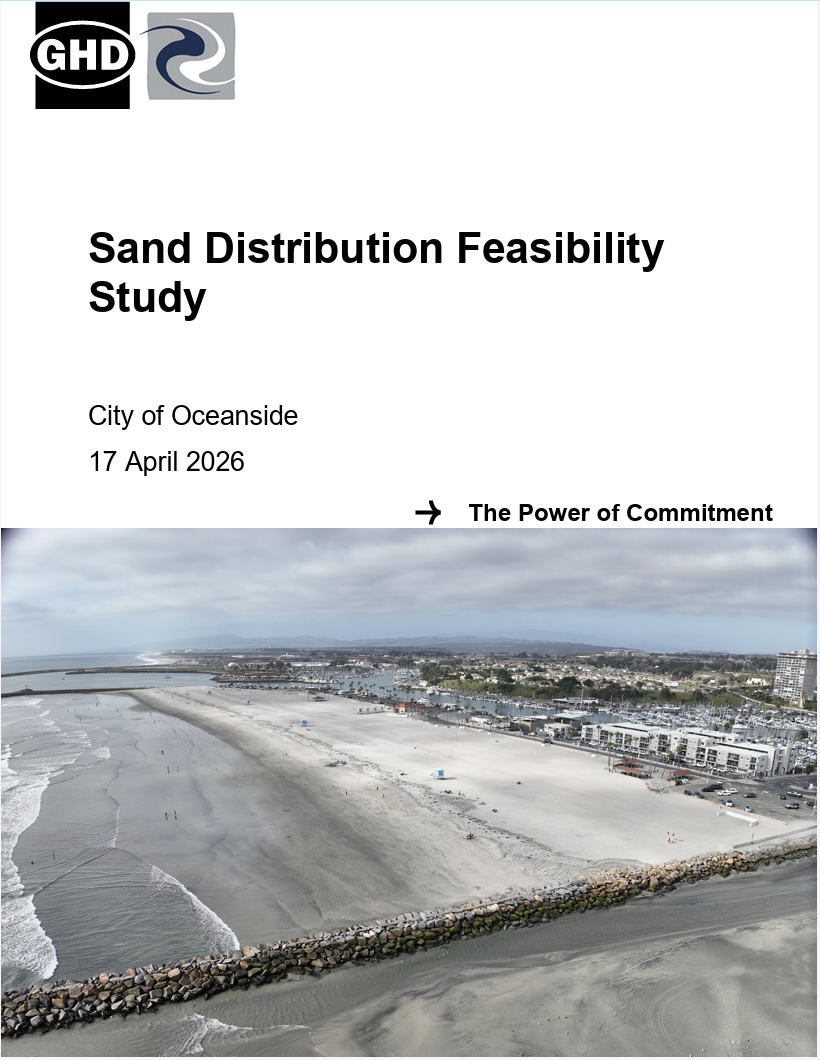
Sand Distribution Feasibility Study
The City of Oceanside’s RE:BEACH project requires substantial volumes of high-quality sand for both initial construction and long-term beach maintenance. Approximately 900,000 cubic yards (cy) of sand is needed for initial nourishment, with potentially up to 500,000 cy of sand required every 3 to 5 years to maintain restored beach widths. To meet these needs, the City completed a Sand Distribution Feasibility Study to evaluate cost-effective and reliable sand sources and subsequent delivery strategies. The study incorporates current scientific understanding of sediment transport across the world, regional sand management practices, and available local and regional sand resources, while also considering lessons learned from prior efforts such as the U.S. Army Corps of Engineers’ Experimental Sand Bypass System. Two primary sand delivery scenarios were evaluated:
Scenario 1: Fixed Harbor Bypass System
This scenario considers construction of a fixed or semi-fixed pipeline system to transport sand from the Camp Pendleton fillet and Santa Margarita River area across Oceanside Harbor to City beaches. While technically feasible, this approach presents significant constraints, including limited access to sand sources under U.S. Marine Corps jurisdiction, complex regulatory and interagency coordination requirements, high upfront capital costs, and extended delivery timelines. The estimated cost to deliver 500,000 cy is approximately $88.3 million, with considerable uncertainty. This scenario carries substantial financial, operational, and jurisdictional risks.
Scenario 2: Mobile Offshore Dredging
This scenario evaluates the use of mobile dredging operations to source sand from offshore borrow sites and place it directly on City beaches. This approach reflects established regional practices and offers several advantages, including readily available compatible sand sources, no requirement for permanent infrastructure, flexibility in implementation, and the ability to deliver large sand volumes in a single campaign. The estimated cost to deliver 500,000 cy is approximately $12.6 million, with a narrower range of uncertainty and greater cost reliability.
The study demonstrates that while multiple sand sourcing strategies are technically feasible, they vary significantly in terms of cost, risk, permitting complexity, and implementation timelines. Identifying reliable and cost-effective sand sources will be critical to the long-term success of the RE:BEACH project and the City’s broader coastal resilience objectives.